

Daily Maintenance Guide for Gas-Powered Go-Karts
Greetings to all KUPAO KARTING owners and operational partners! Today, speaking from the perspective of frontline operations, I’d like to discuss the daily maintenance of gas-powered go-kart engines. Although go-karts are small, their engines—much like those of standard automobiles—have their own "temperaments" and require meticulous care. The steps outlined below constitute the mandatory routine we perform at our facility every day after closing hours.

Step One: The Air Filter—The Engine’s "Protective Mask"
Open the air filter housing, unfasten the clips, and remove the filter element. Carefully inspect the surface of the filter mesh for any dust accumulation or foreign objects causing blockages. If only surface dust is present, use compressed air to blow it clean from the inside out; alternatively, gently rinse it with a neutral detergent and allow it to air dry naturally. Note: When cleaning, *never* scrub vigorously; if the filter mesh becomes damaged, it must be replaced immediately. Once dry, reinstall the filter element in its original position, ensuring a tight and secure seal. This step directly prevents dust particles from entering the cylinders and causing piston/cylinder damage (known as "scoring").
Step Two: Carburetor Cleaning—Say Goodbye to Unstable Idling
The carburetor is the critical component responsible for mixing fuel. After removing the carburetor, use a specialized carburetor cleaner to spray and flush out the various jets and fuel passages within the unit. Pay particular attention to cleaning the fuel nozzle and removing any gummy deposits accumulated inside the float chamber. After cleaning, inspect all gaskets and seals to ensure they remain intact. We recommend performing this procedure every 50 hours of operation, or whenever you encounter difficulties starting the kart or experience hesitation/stuttering during acceleration.
Step Three: Oil Check and Change—The Engine’s "Lifeblood"
Locate the dipstick on the side of the engine; pull it out, wipe it clean, reinsert it fully, and then pull it out again. Observe the color and viscosity of the engine oil: *Excellent Condition:* Golden and transparent; *Critical Condition:* Grayish-black but free of gritty particles—can continue to be used; *Must Be Changed:* Milky-white (indicating water contamination), thick and pitch-black with visible metal particles, or noticeably cloudy. When changing the oil, unscrew the drain bolt located at the bottom of the engine to completely drain the old oil. Then, refill the engine with a 4-stroke engine oil that meets or exceeds the API SG standard and has a viscosity rating of 10W-40; ensure the oil level on the dipstick remains between the upper and lower indicator marks.
Step 4: Starting Recoil and Chain Drive System
Check whether the recoil starter rope on your gas-powered go-kart retracts smoothly. If the rope suddenly jams halfway through the pull, or if you feel a sensation of "slipping" or free-spinning when pulling it to its full extension, it indicates that the internal ratchet mechanism within the recoil assembly is worn out; it is recommended to replace the entire assembly directly. Simultaneously, check the tension of the drive chain—press down on the center of the chain with your finger; there should be approximately 10–15 mm of slack (deflection). If the chain is too loose, it may skip teeth; if it is too tight, it will accelerate wear. Lubricate the chain once every two weeks using a specialized chain lubricant; strictly avoid using standard engine oil as a substitute, as it tends to attract and trap dust.
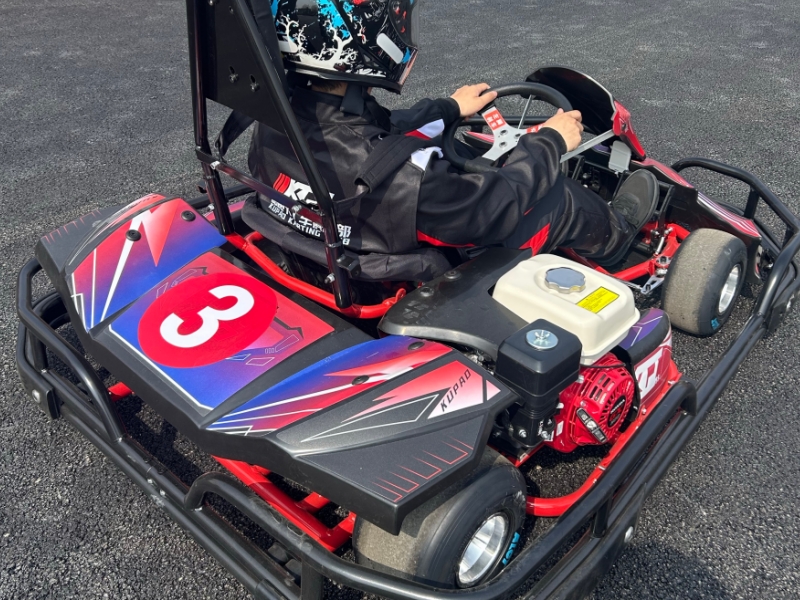
Step 5: The Spark Plug—Your "Ignition Key"
Remove the spark plug cap and use a spark plug socket to unscrew the spark plug in a counter-clockwise direction. Observe the color of the electrode: *Normal:* Brick-red or light brown; *Heavy Carbon Buildup:* Black, wet carbon deposits—clean with a wire brush and then adjust the electrode gap back to the standard 0.6–0.7 mm; *White or Melted Electrode:* Indicates an overly lean fuel mixture or overheating—the carburetor requires adjustment; *Severely Eroded Electrode:* Replace the spark plug immediately. Many issues involving "hard starting when hot" or "intermittent stalling" can be resolved simply by installing a new spark plug.
A Final Reminder
Routine maintenance for a gas-powered go-kart is not a major overhaul; spending just 15 minutes each day performing the checks outlined above can prevent 90% of potential breakdowns on the track. Remember two absolute "Don'ts": *Never* use compressed air to blow out the air filter (this forces dust particles into the intake tract), and *Never* drain the engine oil while the engine is hot (this poses a severe burn risk and leaves behind more residual old oil). At KUPAO KARTING, every single kart relies on attention to these small details to perform at its absolute best. Before you hit the track for some real-world action, make sure your tools are close at hand—you’ll be glad you took the time to be thorough.


